
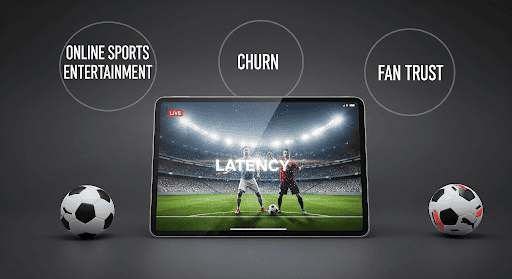
Sports Fans No Longer Forgive a Slow Screen
Sports entertainment in 2026 is no longer just about rights, stars, commentary, or camera quality. Fans expect the stream to behave like the stadium. If the goal appears on X before it appears on the screen, the platform has failed.
That expectation gap defines modern sports media. Viewers complain about subscription costs, blackouts, buffering, low bitrates, app crashes, bad audio sync, and fragmented rights. But latency is the one defect that poisons everything else because live sport loses value when it stops feeling live.
Content attracts fans. Timing keeps them.
The Complaint Pattern Is Brutally Consistent
A review of fan discussions on Reddit, X-style social feeds, sports forums, and streaming-industry reports points to the same core frustration: viewers will tolerate imperfect commentary before they tolerate delay. A fan can mute bad analysis. A fan cannot unsee a spoiler.
Common complaints cluster around five issues:
| Fan complaint | Why it causes churn |
| Stream delay | Social spoilers, betting mismatch, group-chat ruin |
| Buffering | Breaks live tension |
| Price stacking | Fans need too many subscriptions |
| Rights fragmentation | Games become hard to find |
| Audio/video sync | Commentary reveals action before video |
The unexpected lesson is plain. Latency is no longer a technical footnote. It is a retention problem.
Betting Platforms Need the Screen to Keep Up
Live sports betting depends on timing because odds move around events, not after the emotional moment has passed. A delayed stream can show a corner, an injury, a red card, a touchdown, or a three-pointer after the market has already reacted. That is why a user checking online betting Philippines needs odds, live scores, market suspensions, and bet-slip acceptance to feel synchronized with the actual event. The bettor is not only watching sport. They are reading a live probability feed beside it. When the screen trails by 30 or 60 seconds, the experience becomes less like entertainment and more like stale information.
Casino streams carry a different form of urgency because the event is contained inside the platform rather than broadcast from a stadium. A roulette round, blackjack hand, or baccarat shoe still depends on visible flow, dealer pace, table limits, and clear settlement. A polished online live casino experience protects that rhythm by keeping stream quality, navigation, and game switching stable during short sessions. The user is not waiting for a referee or broadcast truck. The pressure comes from the next hand, next spin, or next table decision.
Slot and casino lobbies also compete for attention during sports breaks, halftime windows, and late-night browsing. A player moving from a match screen to online casino games expects filters, quick loading, clear game categories, and recognizable mechanics. RTP, RNG, volatility, scatter triggers, and bonus rounds matter more than decorative packaging once the session begins. The modern entertainment user has little patience for friction. If the game loads slowly, another tab wins.
The 2026 Latency Problem Has Numbers Behind It
Stats Perform’s 2026 Super Bowl latency study found that some streams lagged up to 62 seconds behind the on-field action. That is not a small gap. It is enough time for a touchdown to hit social feeds, group chats, sportsbook markets, push alerts, and neighbor noise before the viewer sees the snap develop.
Industry analysis in 2026 also shows that best-in-class platforms are pushing toward roughly 9 seconds, with a near-term target around 5 seconds for broadcast-like sports viewing. For interactive sports products, sub-second delivery already exists as the technical ambition.
Fans do not describe it in those terms. They say the app is behind. They say the feed is dead. They cancel.
Reddit and X Reveal the Emotional Layer
The most useful fan complaints are often not polished reviews. They are angry posts made during a live game. Reddit threads around YouTube TV, Max, Fubo, NBA League Pass, Peacock, and Super Bowl streams show the same words again and again: lag, buffering, delay, audio ahead, spoiled, unwatchable.
X-style match threads make the problem worse. The fastest screen becomes the social clock. Anyone behind it becomes a delayed viewer inside a real-time crowd.
That is why latency beats content as a churn trigger. Fans subscribe for the game. They leave when the game reaches everyone else first.
Price Still Matters, But It Is Not the Whole Problem
Sports fans also dislike paying across multiple platforms. AP-NORC polling in 2025 found widespread frustration with the cost and complexity of watching live sports, especially when fans need cable plus sports-only streaming services.
But price pain becomes worse when the stream underperforms. A fan paying more than before expects fewer delays, not more. High cost plus high latency creates the most toxic user equation in sports media.
What Fans Expect Now
A competitive sports entertainment platform in 2026 needs:
- Low-latency live video
- Stable bitrate during peak events
- Clean audio/video sync
- Fast app launch
- Easy game discovery
- Live stats that match the stream
- Betting and fantasy compatibility
- Transparent rights information
- No forced app-hopping during major events
The old promise was access. The new promise is immediacy.
The Platform That Wins Feels Closest to Live
Fans are not asking for science fiction. They want the goal, punch, touchdown, overtake, wicket, or buzzer-beater to arrive before the spoiler. They want the app to survive peak traffic. They want the odds, stats, and stream to agree.
That is the real expectation gap. Sports platforms sell content. Fans judge time.