Interview: Getting to Know Lost Velvet
Lost Velvet are carving a space between post-rock atmosphere, shoegaze haze, and industrial unease with a sound that feels vast, intimate, and slightly unhinged. They release their debut album Dark Cells on Friday 4th September, led by their brand-new single and video, Right Back, which is out now. In this interview, we get to know them a little better.
1. Hello! Thank you for taking the time to chat to us. First things first, tell us a little bit about yourself and how you got started.
Rob: We first got started when Mel contacted me online. I had an advert up looking for a bassist to complete a jazz trio I was trying to put together. Instead of finding a bassist, I found Mel – a vocalist. I had the beginnings of a rock project with several songs but no band to play them. As soon as we added Mel’s vocal over mine, we felt we had found something.
2. Someone comes to you and asks you to sum up what kind of music you play – what do you tell them?
Rob: I think the stratification of rock music into thousands of splintered and idiosyncratic genres is not helpful to artists like us who have been inspired by mainstream pop culture for so long. We are often labelled ‘shoegaze’, but a lot of people I have spoken to who enjoy our music have never even heard of shoegaze. By pigeonholing bands into smaller and smaller subcategories, I feel it narrows the audience and reduces the opportunities for bands to find new fans. Radiohead were always referred to as ‘Alternative Rock’, but clearly, Idioteque is not an alternative rock song.
I would simply say we are a rock band inspired by acts such as Radiohead, Jeff Buckley, Alice in Chains, Deftones etc
3. What’s currently keeping you busy? A new album/EP/single release? A new video? Playing live, or planning ahead?
Rob: We are always busy it seems! Mel is working on the video for our next release and we have upcoming gigs, including an acoustic set which requires a total overhaul of how the music is performed. I am also in the process of finalising our track listing for the next album. We have at least fifteen finished songs that we intend to release in the future.
4. What is it about this current period that is particularly exciting for you?
Rob: For me, it is the feeling of momentum that we are creating. I have been in bands since I was a teenager, and it is very difficult to keep a feeling of momentum. We have had setbacks in this project that could have derailed us were it not for some excellent manoeuvres by Mel. Often projects show great potential but fall at hurdles further down the line. At the moment, we have an album coming out, gigs booked and the feeling that we are on a positive trajectory. That momentum is oxygen for the project.
5. Tell me about the work that has gone into making it a reality and what it means to you.
Rob: If by ‘it’ you mean the album, I would say (at risk of sounding dramatic or cliche) that it is a life of creating music that has gone into it. Starting on the piano and playing in bands for so long, writing soundtrack, classical and jazz music – all these phases were necessary to get here. Creating music means the world to me and it has now become a compulsion, so it is hugely important to me that I feel we have officially started our journey and we have begun to create an outlet for all of these ideas.
6. Making music and being creative can be a very positive experience and can be very good for the mind. In what way has making music had a positive impact on your mental health?
Rob: Personally, it would be playing the piano. I have played since a young age, and I do think it helps you mentally. To be able to play the piano and express yourself is a privilege. It can also be very cathartic.
7. It can also be incredibly challenging, more so in the modern times. What have been some challenging aspects of making music and how have you overcome them?
Rob: Constant failure makes any endeavour difficult. A lot of skills people accrue; they do so for money or security – music nowadays offers none of these things. The fact that music takes so much time and energy and offers so little in return by way of remuneration means one has to constantly overcome the innate desire for security and prosperity and instead devote yourself to a task that rewards mostly spiritually. I would also add that trying to make professional quality music independently whilst holding down a mind-numbing and life force-sucking job would be a task for any musician, regardless of their place in the industry.
8. How do you handle the online aspects of being in a band? Having to put out content constantly, promoting across several different social media platforms, and having your success measured in likes and follows?
Rob: To me, social media is anathema. I simply refuse to partake in it. As such a stubborn and anachronistic person, I consider myself incredibly lucky to have found Mel. Although she is hardly enamoured with social media, Mel has far more experience with it and manages to use it creatively and genuinely for the benefit of the band.
Mel: I thought I’d jump in as soon as I heard the words social media because I know Rob will already be slowly drifting backwards into an abyss. I do take on the online side of the band, but there was a point where trying to feed every platform constantly became completely overwhelming. It felt as though you could spend more time proving you exist than actually creating the music. So we made a conscious decision to simplify things. We mainly focus on Instagram, with Facebook integrated alongside it, and we let everything else take a back seat for now! We’ve also stopped chasing every tip that’s supposed to please the algorithm. Lost Velvet was never going to be the kind of band that films what we had for breakfast or forces ourselves into trends that don’t feel like us. The music comes from a very private, immersive place, and we’ve realised the way we present it should come from that same place too.
Rather than trying to be everywhere all the time, we’d rather create something that feels like an extension of the world we’re building. A fragment of a song, a cinematic visual, or a photograph that captures the atmosphere.. if someone discovers us through one of those moments and feels compelled to step inside our world, that’s far more meaningful to us.
Of course, likes and follows seem to be some sort of popularity score, but they’re not a measure of whether the music has connected with someone.
9. How do you make this part of things enjoyable, and fulfilling, for yourself?
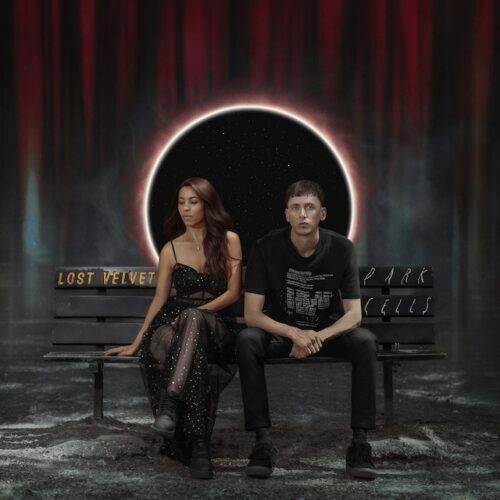
Mel: Honestly, the part I enjoy isn’t social media itself, it’s the creativity behind our vision. We’ve been really lucky to build a small team of incredibly talented people who all instinctively understand the same dark, cinematic world we’re trying to create. We’ll sit down and plan video shoots, photography and visual concepts, then work out how to bring them to life on a very limited budget. Everyone brings something different, and that makes the whole process feel genuinely collaborative. For example, when we asked our photographer, Natalia d’Ark, if we could add tiny stars to the portal on the Dark Cells album cover, she painted them on. We loved that.
We tend to choose quality over quantity wherever we can, so hopefully by the time something is finished and shared, people see it as more than just content. They see it as another expression of our world.
10. Speaking directly to listeners – what would you ask they do to help support you?
Rob: Listen to the music without expectations or preconceptions, preferably more than once. Our songs tend to reveal themselves over time rather than all at once.
Mel: If you do vibe with a track, give yourself the space to get lost in it. Go for a drive, take a walk with your headphones on, and let it unfold. And if a song connects with you, let us know. Whether it’s a DM or a chat after a show, we love finding out more about our listeners and how our worlds connect.
11. Outside of music, what do you like to do to relax?
Mel: I go to the gym to recalibrate, swim to relax, music festivals in the summer, drinks with friends and a good movie night.
Rob: I enjoy basketball, cycling, reading, cooking, movies and the pub.
12. Where can people find you?
Rob: The pub.
Oh, you mean online. Links below.
Spotify | Pre-save | Instagram | Facebook