
How Riot Built One of Gaming’s Coolest Aesthetics with Valorant
When Riot Games launched Valorant in June 2020, the tactical shooter market was already crowded. Yet within months, the game carved out a distinctive identity that transcended gameplay mechanics. Valorant’s aesthetic – a vibrant fusion of near-future technology, diverse cultural influences, and deliberate artistic restraint – has become one of gaming’s most recognizable visual signatures.
The challenge was formidable: create a world that felt fresh while maintaining the visual clarity demanded by competitive play. Too much visual noise would frustrate professional players seeking clean sightlines. Too little personality would leave Valorant feeling generic. The solution lay in stylized credibility – grounded enough to feel plausible but stylized enough to allow creative expression.
The Commercial Stakes of Visual Identity
Valorant’s aesthetic choices carried significant commercial implications beyond artistic merit. In competitive gaming, visual distinctiveness directly impacts broadcast viewability and esports marketability. For instance, when spectators get involved with betting on Valorant games at Thunderpick, they need to instantly parse complex team fights and ability interactions. The game’s high-contrast color palette and clean character silhouettes make these moments comprehensible even to casual observers, which has proven crucial for audience retention during tournament broadcasts. Esports betting platforms benefit from this clarity. When viewers can easily follow the action, they engage more deeply with competitive outcomes and strategic nuance.
This commercial necessity shaped fundamental design decisions. Character designs needed instant recognition from silhouette alone, ensuring split-second identification even in chaotic firefights. Map environments required distinctive color palettes that would remain consistent under different lighting conditions and broadcast compression.
Cultural Fusion as Design Philosophy
Riot’s approach rejected the homogeneous future aesthetic common in sci-fi shooters. Instead, Valorant presents a near-future Earth where regional cultures haven’t been erased by globalization but enhanced by it.
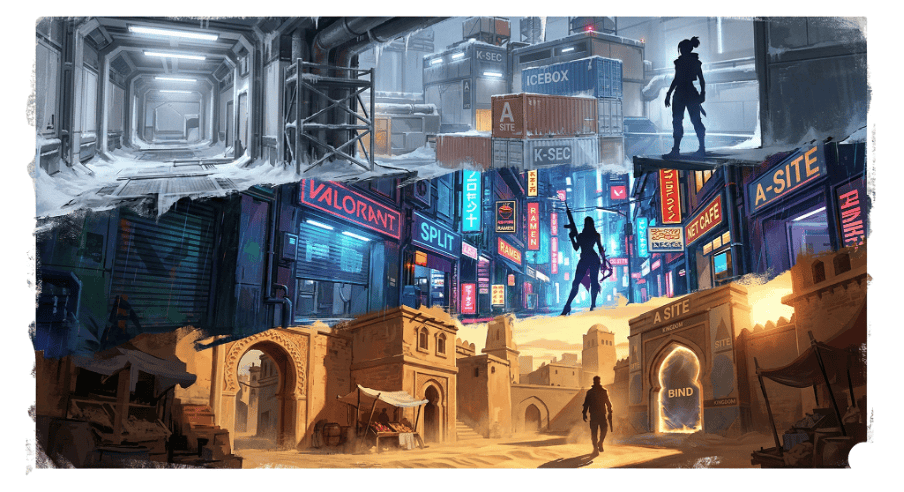
Maps demonstrate this philosophy clearly. Icebox transforms a Russian facility into a vertical playground of stark whites and industrial blues. Split presents Tokyo where traditional architecture coexists with holographic advertisements. Bind draws from Moroccan coastal cities, featuring warm sandstone facades alongside futuristic teleporters.
Character designs extend this principle. Jett’s Korean streetwear aesthetic combines high-fashion with tactical functionality. Astra’s Ghanaian-inspired cosmic powers visualize African cosmology through science-fiction. Phoenix’s London roots inform everything from his voice lines to his jacket design, creating authenticity that resonates with players while introducing others to visual traditions they might not encounter elsewhere.
Restraint as Competitive Advantage
Perhaps Valorant’s most crucial aesthetic decision was what Riot chose not to include. The game deliberately avoids the visual excess that characterizes many modern shooters. Particle effects remain subdued compared to games like Apex Legends. Environmental details serve gameplay function first and atmospheric decoration second.
The development team established strict visual hierarchy rules. Player models always read clearly against environments. Ability effects use distinct colors and shapes that communicate information instantly. Important gameplay elements never compete visually with decorative details. These rules forced the art team to be more creative within constraints.
This philosophy extended to weapon design. Valorant’s arsenal features near-future firearms that feel grounded in contemporary gun design while incorporating subtle sci-fi elements. The Vandal maintains recognizable AK-47 proportions but adds angular plating. The Operator evokes the AWP’s profile while introducing holographic sights. Players familiar with Counter-Strike can immediately understand weapon roles, while the aesthetic freshness prevents the game from feeling derivative.
Animation and Sound Design Integration
Valorant’s aesthetic extends beyond static visuals into how things move and sound. Riot employed distinct animation principles for each agent. Jett’s movements feature quick, sharp motions reflecting her personality. Brimstone’s heavier animations communicate military experience. These choices make agents feel mechanically distinct even when hitboxes remain identical.
Sound design works in concert with visual language. Each ability features audio cues matching its appearance. Sova’s dart whistles distinctively, while Killjoy’s turret emits mechanical whirring. This audio-visual synchronization reduces cognitive load, allowing faster information processing.
The UI demonstrates similar integration. Menus feature clean geometric shapes and high-contrast typography mirroring in-game visual language. The kill feed uses character-specific colors matching agent designs. Loading screens maintain consistency, presenting lore and concept art that reinforce visual rules.
Evolution and Community Response
Since launch, Riot has refined Valorant’s aesthetic through careful iteration based on professional player feedback. Early concerns about visual noise during ability-heavy team fights led to particle effect adjustments that maintained spectacle while improving readability. Map redesigns have prioritized sightline clarity without sacrificing environmental character.
The community has embraced Valorant’s look as essential to its identity. Fan art proliferates across social media platforms, with artists drawn to the game’s distinctive character designs and vibrant color palette. Cosplayers have adopted Valorant agents as popular subjects, indicating that the aesthetic resonates beyond gameplay contexts.
Valorant’s aesthetic success demonstrates that competitive games need not sacrifice visual personality for gameplay clarity. By establishing strong design principles, maintaining disciplined restraint, and integrating cultural authenticity with speculative technology, Riot created a world that serves both competitive and creative ambitions. The result is a visual language that has influenced how other developers approach tactical shooter design.