3 Horror Movies Better Than Original Books
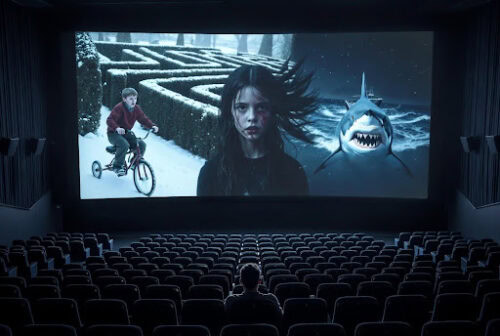
Some horror films don’t just nick a story from a book — they completely obliterate it. Sure, novels carry their own weight, but every now and then a director grabs a so-so paperback or a decent read and cranks out a proper nightmare that leaves the original choking in the rearview. These three movies prove cinema can out-terrify literature when the right mad bastards get behind the camera.
The Shining — Kubrick’s Nightmare Trumps King’s Novel
Stephen King has never hidden his disdain for Stanley Kubrick’s take on The Shining, but honestly, that tells you more about King’s attachment to his own work than it does about the film’s quality.
The novel drowns everything in Jack Torrance’s baggage — the drinking, the temper, the guilt from breaking his boy’s arm. It reads like a character piece wearing a haunted house costume. Kubrick ditched all that psychological navel-gazing and served up something far more disturbing: pure, inexplicable evil that doesn’t bother explaining itself.
King’s version wraps everything up nice and neat with a boiler explosion and Jack finding some shred of redemption. Kubrick’s version ends with that eerie photograph, hinting that Jack belonged to the Overlook’s darkness all along, trapped in an endless loop of evil. One offers closure; the other offers nightmares.
What the film does better:
- Replaces King’s redemption narrative with pure psychological dread
- Uses cinematography and sound design to create unease without exposition
- Leaves Jack’s backstory ambiguous, making him more menacing
- Delivers an ending that haunts viewers long after the credits roll
- Transforms the Overlook from a haunted building into a living, malevolent entity
The film doesn’t explain why the Overlook is evil, and that’s precisely why it works. King needed reasons; Kubrick needed atmosphere.
Terrifying Pokies That Channel Classic Horror Films
The horror genre translates beautifully to PayID pokies, with Australian punters embracing terrifying themes on the reels:
| Horror Pokies | Developer | Vibe |
|---|---|---|
| Blood Suckers | NetEnt | Vampire thrills with solid RTP |
| The Dark Knight Rises | Microgaming | Gothic darkness meets superhero action |
| Immortal Romance | Microgaming | Vampire romance with a sinister edge |
| Halloween | Microgaming | Michael Myers chases across the reels |
Pokies PayID platforms offer Australian players a growing collection of horror-themed slots that tap into the same psychological thrills found in classic scary films.
The best PayID pokies Australia sites regularly rotate their libraries to include horror releases, keeping things fresh for punters who love both spins and scares. For those chasing the fastest access, instant PayID pokies Australia options provide seamless deposits so punters can dive straight into spine-chilling reels without missing a beat.
The Exorcist — A Slow Burn That Outpaces the Novel
William Peter Blatty wrote The Exorcist as a rumination on faith and doubt, but the film throws all that theological navel-gazing out the window and goes straight for the jugular — a little girl twisted by something demonic, and the visceral nightmare of watching her fall apart.
The pacing deserves credit too — it takes time establishing Regan as a normal kid before the possession takes hold, making the supernatural elements hit harder. That gradual descent into madness makes the supernatural elements hit harder.
Key moments that work better on screen:
- The spider-walk scene down the stairs (not in the novel)
- The crucifix assault that pushed censorship boundaries
- Father Karras’s doubting question to the possessed Regan
- The subliminal flashes of a demonic face throughout the film
- The final exorcism sequence with its gruesome physical effects
Blatty later admitted he used the film’s visual possibilities to enhance his original vision. The movie version of The Exorcist isn’t just a better horror story; it’s a masterclass in cinematic terror.
Jaws — The Film That Killed the Novel’s Subplots
Peter Benchley’s novel Jaws spends more time on an affair between Ellen Brody and Hooper than it does on the bloody shark attacks. The movie famously ditched that whole romance angle and kept the focus exactly where it belonged: on the massive great white terrorising Amity Island.
Audience reactions — film vs novel:
| Aspect | Film | Novel |
| Iconic status | Timeless classic | Well-regarded thriller |
| Scary moments | Intense and visual | Less impactful on page |
| Pacing | Tight and focused | Meandering subplots |
| Ending | Explosive and satisfying | More cynical and drawn-out |
| Dialogue | Snappy and memorable | Functional and explanatory |
The film’s editing creates tension in ways the novel never could. That famous opening scene with Chrissy getting attacked at night works because viewers don’t see the shark clearly. The mechanical shark constantly broke down during filming, forcing Steven Spielberg to rely on suggestion rather than visual effects. That limitation actually made the film scarier.
Benchley’s novel has a lot of shark action, but it also gets bogged down with mafia subplots, police corruption, and the aforementioned affair.